Showing posts with label Education. Show all posts

Wednesday, February 11, 2009

A Series of Videos

Seeing is believing and these videos show different reactions to understanding a seizure.

First, a series of Canadian public service announcements illustrating a grand mal and absence seizures:


Personally, I enjoyed the MTVesq informative dance.  It will be my cover story for my killer flailing dance moves from here on out.  The kids in this video may be the most well informed youngsters on the planet.  However, it makes sense to help kids not freak out if a friend has a seizure.  

The other really help give a sense of how weird and confusing an absence seizure can be for observers.  After all, we've all had the space out moment when our mind wanders or we're bored.  Honestly, I don't know if I would be able to identify this type unless I was able to talk to the person.  What I took away from this video is that the difference from spacing out is that despite trying to get the person's attention there is no response until the seizure is over.

The rush to judgment that comes with unfamiliarity is the most frustrating for me.  It feels almost impossible to educate that though seizures may effect work in the short term, they do not eliminate the capacity to be an effective and competent professional.  

A commentator recently pointed out another assumption that has to be challenged: the idea that lifelong conditions will go away or can be cured permanently.  Unspoken is a sense that continued problems after being on meds or knowing about the condition are from laziness or irresponsibility.  It is difficult to clarify that a condition can be "managed" but will continue for a lifetime.

And occasionally lead to interpretive dance as an explanation :


Oh yeah baby...

Thursday, January 8, 2009

Activity Time! Hey Kids--Experience the Fun of Drugs Without the Experience of Cops

Hey Kids! Sick of these laws that don't let you experience the groovy side effects of mind altering substances?

"F*ck yeah!! Those regulations from the man totally infringe upon my freedom, man. This is AMERICA dude (places left hand on heart and hums Proud to Be an Merican)!"

Yes..yes...you aren't able to release your mind from prison of regular life? If you find drugs that help you do that--well, they are hard to get because of all these laws. Expensive too!

"It TOTALLY blows. I'm being OPPRESSED. It's my body! I'm moving to Canada where you can get drugs, like, free 'n stuff."

Not being able to do whatever you want OR having to experience long Canadian winters? That doesn't sound too nice. Would you like to experience what a totally hard to score drug does? For FREE!

"That is AWWWWWWWWWWWWESOME. OMG--you are the awesomeist. Thanks for the hookup dude."

Okay...right. But supplies are limited--you have to totally have a chronic disease to get your hands on it. It's called Dilantin. Street name: $$300monthly$$; Lamotrigine, or BSC (Blurry Spin Cycle).

Chronic disease??...ooooohh...I get it. Like it needs "Chronic" treatment at 4:20 everyday?

Umm..well that might be one option in California. However, yes, you are sort of on target. It needs treatment everyday--sometime more than once a day. And you can't miss a dose or risk a lower grade of the drug. Quality matters.

So I'd have to take it ALL the time to keep getting its effect? Like crack?

Not exactly like crack. As in not at all. But yes, you want it everyday.

So what does it feel like? Oh shit, you said I could free my mind for free. How do I do that?

Well, I'll tell you--I totally got to experience this last month. It was very memorable. Here's what you do [KIDS--YOU CAN TRY THIS AT HOME. JUST DON'T TELL YOUR PARENTS*

Step 1: Eat. Eat seven bowls of ice cream, three pop rocks, slam some red bulls and vodkas, grape pop, shot gun some of Milwaukee's Beast, kick a magnum of champagne, a bag of Cool Ranch Doritos, a glass of warm milk and a glass of warm orange juice. And a sloppy joe.

Umm...that sounds kind of gross. But if it gives me the munchies, I guess I'm just heading them off at the pass.

Something like that. Okay,
Step 2: Prepare for the Hit: Remember as a kid spinning around for fun? Yeah, it was great!

Totally--I haven't done that in years *burp* I can't believe I ate all that in 20 minutes. I'm an eating champ.

Amazing eating skills note. Well you're going to give a great childhood activity a shot again. But you have to EXACTLY this way: Find an open space and spin for 2 minutes as fast as you can. Then you are going to headbang as rockingly as you can for two minutes. Putting on some AC/DC might help in this whole process. Then spin and head bang for three more sets. Now do a keg stand IMMEDIATELY. You have to chug for one minute or you'll be a pussy. Two more sets of spinning/head banging and then the capstone: 10 tequila shots. Screw the lime and salts--you are way too hardcore for that bullshit.

"Dude that sounds intense."

But it will work. Oh, and get your friends to film you. This will get like a billion hits on youtube.

Step 3: Take the Hit.
Ready?? Full of all those great snacks and pre-drinking efforts? Okay.
GO MAN GO!! [Hahahaha! D.A.R.E. never worked!! Caving to peer pressure is what it is all about!]

SPIN!!
ROCK OUT!!
SPIN!!
IT'S TOO MUCH METAL FOR ONE HAND--HEAD BANG LIKE IT IS 1985!!
SPIN!!
HEADBANG!!
SPIN!!
HEADBANG!!
CHUG! CHUG! CHUG! CHUG! CHUG! CHUG! CHUG!
TURN RIGHT ROUND BABY RIGHT ROUND!!
HEADBANG!!
SPIN!!
HEADBANG!!
DRINK!
DRINK!
DRINK!
Keep going man--it's like spring break 2001!
DRINK!
DRINK!
DRINK!
DRINK!
DRINK!
TWO to GO--Don't quite now!
DRINK!
DRINK!

Whoooooooo! HOooo!

"Oh dude...ooooo god........the room...is...spinning. Why is the floor rolling up and down in waves?!? I can't see....ahhhhhhh....I want to die. THIS SUCKS!!"

"Baaaaaaaaaaaarf...
Barf.

Retch...gag.

BAAAAAAAAAAAAAAAAAARRRF."

[Hey--Some puke is on your sleeve. And your cheek.]

"Fuck...blaaaaaaaarph...gasp...gasp...pukkkkkkkkkke....you."

Hehehehe...you know that's how I felt too. It is TOTALLY like what sometimes happens when you take that mind altering drug--Lamotrigine. It chills out seizie brain but there is a little vertigo every once in a while.

"Vertigo!!! But the room is spinning! I can't see straight! I'm warrfffing, drooling and holding onto the toilet like it is an anchor in a hurricane. .....hhhhrulppp...."

Yeah...well--lesson learned, eh? Maybe there is a REASON that this mind altering substance is pretty regulated. If you don't really really need its effects, then maybe putting up with the side effects isn't really worth it.

And vertigo sucks. I hope you never have to experience it unless it is self imposed.

KIDS**!! Disregard that sensible advice in the previous sentence--adults are too lame to listen to anyway. You to can enjoy the fun effects of having an interesting condition like epilepsy. You should test drive it. A little self-imposed vertigo is a pretty interesting experience.

"...barf... I hate you."

*Don't tell them right away at first. It would interrupt them laughing at your antics. They might be able to help you out once they stop giggling.
**Demented readers--you can test drive this as well. Share your experience in the comments. BETTER YET! Film it and post it to youtube and get that link up! It's an experiment--so actually doing science. Doing stuff for SCIENCE IS (almost) ALWAYS COOL.

Thursday, August 28, 2008

Scatter Pills Like Rose Petals (Skipping/Bluebirds Mandatory)

I've received FANTASTIC news in the past two weeks (yes yes...I realize that I've conformed to the rules of bad bloggering--not posting regularly to my addicted audience of two)

Lamictal, the drug I use to dumb down the seizures has.....

Oh jeez...the downside of writing is that it occasionally leads to research. I did not realize that Lamictal is also used to treat bi-polar disorders. Though being bi-polar is clearly a serious condition, it also scares the hell out of me (see crazy cat lady fears). This fear may not be normal or rational. But the kid logic that immediately popped into my head was "if Lamictal treats epilepsy and bipolar could taking it mean that I could get or have both?" Does sulking count as an "acute mood episodes"? Srsly..."acute mood episodes"? I can't imagine anyone with the brain chemistry slightly off saying, "Ooo I think I'm having an acute mood episode and that's why I've thrown your car across the street a la Hulk.

Clearly, no. Let's move on.

So LAMICTAL is the brand name of an antiseizure medication called lamotrigine. In my case it does a great job of stopping the brain fibrillation without the wacked-out side effects of Dilantin. I feel like a pretty normal person on Lamictal. But if I forget a does...well I start to forget. I missed a half dose last week and spent the next three days foggy and senile.

But here's a great incentive to not get addicted to these "life saving" drugs. They are expensive.

I spent about a sixth of my monthly income on drugs--roughly $3600 per year. 99% of that was on the Lamictal. That's more than I save for retirement annually, I could buy two "Menn Quality" cars for that price, or 35 pairs of decent roller skate (and cover tax, shipping and handling).

When my health insurance* switched the coverage to the generic a few weeks ago I saw the price of my prescriptions drop to $4--a 98% savings. Haha! Don't have to choose between eating and seizing!

There's always a catch though, right? Like a lot of generic versions of drugs, they work almost like a name brand. There's something to be said for the real $900 Prada purse and the back alley bag shop products. The discussion boards at epilepsy.com talked about the adverse reactions that popped up when folks made the change. If the generic functions the same at a rate of 70% or more it is an "equivalent" and an insurance company may require filling with the generic.

Okay since there's a pretty big impact on your life when you have a seizure let's assume that it is the equivalent of getting in a car crash that only messes you up psychologically and leaves you sore for 2-3 weeks. Imagine owning an insured car where your chances of being safe from crashes were 95-100%. Then randomly your insurance company replaced your car with a safety probability of as low as 70%. A third of the time you would be "unsafe" if a crash occurred.

Got that? Right.
The Epilepsy Foundation issued a position paper that outlines the concern with replacing reliable "high safety" drugs with generics:
The Epilepsy Foundation is seriously concerned about mandatory substitution of generic antiepileptic drugs without prior approval of the patient and treating physician. Generic formulations of a number of widely used anti-epileptic drugs are available and present the opportunity to reduce costs. Some states and some institutions (including prepaid health plans) have mandated that the pharmacist fill a prescription with the least expensive available drug.
The effect on me? Well it's been a week and a half of memory issues. You know the feeling of waking and remembering snippets of a dream. Yeah...that's been the day to day. My coworkers have been getting blank looks when they ask me about projects, I've forgotten directions to places I've been plenty of times, there's lots of wandering around wondering where I set down that pair of glasses/coffee mug/brush/book/cat. Honestly, until I started writing this blog, it hadn't occurred to me that the fog was from the meds and not the hardware.

I love have affordable drugs. I'd be willing to pay between 5-7% of my income for any type of meds as long as they work so I can work. I trust my docs--they have great training and give a damn about their patients. I like having insurance, especially after NOT having insurance and consequently missing about 10 years of routine maintenance.

Given that it's an election year and we can expect lots of stumping about healthcare, think about the dilemma that law makers, normals like you and me and health care providers face.

  • How much failure can we tolerate with "equivalent" generic and name brand drugs?
  • What happens when they fail?
  • How much can you afford to give up to pay for prescription medication (not healthcare in general, just the pills you pop)?
  • How much is a sixth of your income? At what point is it drugs or food or fake Prada purses?
  • How many of us lose health insurance when the rates get high?
  • Who gets to make the final decision on what pills go into your mouth--you, a doctor or an insurer?
I wish I had bullet pointed answers to match the bulleted questions. In a political year...I'm stumped on this issue.

* Love having it, but there's always more to say about insurance


Wednesday, May 7, 2008

The Clock is Reset

Oh avid readers you are in for a treat.
Another seizure=another six months of blogging.

It only seems fair since I realized that each time the brain clicks off I learn new things about myself and the impact of epilepsy.

One thing I've learned is that I really REALLY pissed that I can't drive for another six months (you have to wait to see if anti-convulsive drugs are doing the trick before insurance companies will cover you). So I'm being a good citizen by reducing my carbon footprint, shopping locally and online, carpooling and all the other things that come hand-in-hand with not driving.

On the upside, skyrocketing gas prices aren't really a big deal for my budget (sorry everyone else).

On the downside, I'm not free to go do what I want when I want and get frustrated by my lack of independence. A lot of normal American life isn't really designed for the carless. Yes, if you live in a major metropolis or an environment that otherwise caters to not having a car (i.e. college towns), its not too bad. But for the rest of the world, double the time it takes to do everything.

It's giving me new appreciation for why it is so difficult for those who can't afford a car, also can't seem to get it together and "pull themselves up by their bootstraps." Its not just the economics of their situation, it is the reduced access to time. Access to time gives us opportunities to uncover creative options and tap resources and relationships that take time to cultivate. Without a car, it is more difficult to physically travel to resources that can change your circumstances. In rural areas, it is virtually impossible.

I'm smart and social with an extensive network of people to tap for help (thanks friends!) so I can't really complain or feel sorry for myself. "Make it work" tends to be a mantra.

Of course, I'll offer you tips when gas hits $7 a gallon this summer and you join the carless crowd.

Friday, March 14, 2008

SUDEP Keeps Me Up at Night

Paula Apodaca at E. is for Epilepsy writes about an unexplained cause of death which poses a risk for epileptics.
Sudden Unexpected Death in Epilepsy, or SUDEP is a term used when a person with epilepsy suddenly dies and the reason for the death is not known. The cause of SUDEP is unknown. Post mortem examination usually reveals no abnormalities in victims.

Of those who die from SUDEP, it is most common in people who have generalised tonic-clonic seizures, especially in young adults. The most important 'risk factors' seems to be poor seizure control, and seizures occurring during sleep.
Great. The napatorium just was redecorated in crypt.

Applied Neurology describes the difficult role health care providers face when educating patients or condoling family members after an unexpected death.
It's a delicate subject, and some patients do not want to know that they are at risk for sudden unexpected death. The question is, does knowing serve a purpose? "When I talk to my epileptic patients, I highlight the risk of injury and accident with potentially fatal consequences," said Michael Sperling, MD, the Baldwin Keyes Professor of Neurology at Thomas Jefferson University and director of the Jefferson Comprehensive Epilepsy Center in Philadelphia. Sperling advises patients, for example, to avoid rock climbing and not to swim without a lifeguard nearby. "But to say, 'By the way, you could suddenly die, we won't know why, and there's nothing I can do about it'-I don't think that serves any useful purpose," he said.

How much should physicians tell patients about the risks of their conditions? Indecision may be bolstered by inaccuracies in data about SUDEP.

Apodaca writes:

In one American study a SUDEP rate of 1 in every 370 people with epilepsy has been suggested. (Leetsma et al 1989). It is however a fact that, through ignorance and misunderstanding - few doctors and even fewer coroners are aware of SUDEP - epilepsy related deaths have often not been accurately recorded and the exact number of deaths falling within the category of SUDEP is not known. By declaring a death resulting from a bath-time seizure as ‘drowning’, or a fatal nocturnal seizure as ‘suffocation’, and by not mentioning the epilepsy connection, valuable research data is being lost.

Personally, I want to know more rather than less. Accurate and comprehensive information helps me avoid inventing explanations to fill the gaps. I'm creative and can find reasonable sounding rationalizations that are about as real as intelligent design.

Certainly unexpected and sudden death is a terrifying prospect but so are many other aspects epilepsy. Individuals should be given access to correct medical information and retain control over how to mentally and emotionally process it. Having an incurable disease does not make you helpless or stupid. Being treated as incapable of facing difficult information is demeaning.

Death comes to us all. Knowing risks associated with a disease at least gives you the opportunity to prepare loved ones, make legal arrangements and make informed decisions about risky activities.

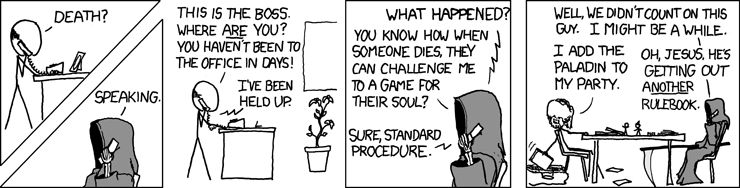
But of course, I have a backup plan to thwart death:


Thanks Gary Gygax for access eternal life in the basement! Our savior was from Wisconsin naturally.

Thursday, March 13, 2008

Nooooooo! Terry Pratchet's Early Onset Alzheimer's

Boing Boing just posted the worst news ever:

Pratchett donates $1 million to Alzheimer's research

Bestselling author Terry Pratchett has donated $1,000,000 to fund Alzheimer's research. Pratchett announced that he had a rare form of early-onset Alzheimer's last December, and he's since discovered that there's an enormous gap in the science of Alzheimer's, noting, "I'd eat the arse out of a dead mole if it offered a fighting chance."

Link
Okay, clearly I'm not upset by the incredible donation to fight a disease of which I live in perpetual terror. I'm a gigantic Terry Pratchett fan and firmly believe that the Discworld novels may be some of the best social commentary of the 21st century. If you haven't read any yet, start with Jingo for commentary on war, international diplomacy, flatulence and the media. Going Postal is my current favorite though and it's shocking how deeply Equal Rites has shaped my attitudes towards breaking the glass ceiling/dimensional divide.

Pratchett's attitude toward having an incurable disease that will eventually destroy his insights, wit, career and identity trumps the significance of his donation.

He writes on Paul Kidby's Discworkld News:
Folks,

I would have liked to keep this one quiet for a little while, but because of upcoming conventions and of course the need to keep my publishers informed, it seems to me unfair to withhold the news. I have been diagnosed with a very rare form of early onset Alzheimer's, which lay behind this year's phantom "stroke".

We are taking it fairly philosophically down here and possibly with a mild optimism. For now work is continuing on the completion of Nation and the basic notes are already being laid down for Unseen Academicals. All other things being equal, I expect to meet most current and, as far as possible, future commitments but will discuss things with the various organisers. Frankly, I would prefer it if people kept things cheerful, because I think there's time for at least a few more books yet :o)

Terry Pratchett

PS I would just like to draw attention to everyone reading the above that this should be interpreted as 'I am not dead'. I will, of course, be dead at some future point, as will everybody else. For me, this maybe further off than you think - it's too soon to tell. I know it's a very human thing to say "Is there anything I can do", but in this case I would only entertain offers from very high-end experts in brain chemistry.

For the edumachationally inclined, here's more about The Alzheimer’s:
  1. Alzheimer’s disease is not a normal, unavoidable part of getting older, but an as yet incurable brain disease.
  2. Care services for Alzheimer’s disease cost the UK more than cancer, heart disease and stroke combined.
  3. There are currently 700,000 people with dementia in the UK. The number of people with dementia is forecast to double within a generation.

Sunday, February 17, 2008

How to Respond to a Seizure

Enough of my blathering about my own head--here's what you can do in response to a seizure.

The Basics:
  • Do Something. You can actually help--don't stand their like a deer in the headlights. At least ask if you can help.
  • The Signs: Before a seizure, its likely that a person will mentally check-out. They'll seem off as though they were suddenly drunk. For example: I get a sense of deja vu that focuses on smell and will generally ask for something with a strong scent (pepper is a favorite).
  • Your Response: Stay Calm, reassure, look for a medical alert bracelet and ask "Do you have seizures?"
  • Relocate: Have the person sit down on the ground. The goal here is to avoid a fall or let them wander into danger (like traffic).
  • Assume the Position: If they go into a Tonic Clonic seizure (shaking & twitching) do these three things:
    1. Roll on Side
    2. Pad & Protect Head
    3. Time the seizure. Greater than 5 minutes= Call 911.
    4. DO NOT PUT ANYTHING IN THEIR MOUTH. They won't bite off their tongue. Jaws atwitchin' are not that strong.
    5. Remind them to breath if they are turning a bit blue.
  • Be a Nice Person: Reassure them when they come out of it. They'll probably be really sleepy so get them to a napatorium or a cab so they can get home safely. If possible write down anything you observed before and after the seizure. It really helps with reconstructing time and generally helps them get back to the exciting world of day-to-day living.
Now go watch TV on the internets to learn more. It totally counts as professional development on your timesheet.

A comprehensive video from the UK that outlines how to respond to a complex partial seizure (the check-out) and a grand mal seizure (twitching):

(About 7 minutes)

Shorter video on complex partial seizures.
Shorter video on grand mal seizures (aka general tonic clonic).

Tuesday, February 12, 2008

Visualizing Epilepsy: Stamps

How do you educate and raise awareness about epilepsy? Tiny pieces of art that move ideas around, aka stamps:


From BoingBoing:
The University of Washington's Neuroscience For Kids site has a fantastic gallery of postage stamps from around the world that feature neuroscience-related themes.


Link