A seizure at the beginning of the weekend erased last week. I do live off my calendar, so there are clues to my overambitious plans. Did I really dutifully return to a project started with immense energy, which has lost its charm? My calendar said I did.
Did I act or did I hope?
The calendar illustrates the holes of my past that I refill with memories that are glimpses out of the corner of my eye. Guesses. Deductions. Aspirations. Doubt.
The guys try to protect me against anxiety by filling in the gaps. They laugh but their anxiety is an under current. The stress is contagious because they can't protect me. There is nothing they can do.
This seizure was disturbing--I don't think I missed meds. Did I take them too late? Was it an outside factor? Work is, or rather was, rich with anxiety.
The upside of a seizure is I forget stress. The brain the stops and lets go.
People pay good money for the same result--let stress vanish. Medications, therapy, drinking, drugs, the gym and contorting their bodies with the hope the brain lets go.
A seizure is very efficient for losing stress.
Showing posts with label Seizure. Show all posts
Showing posts with label Seizure. Show all posts
Monday, October 1, 2012


Wednesday, January 21, 2009
Restarting Hope in Our County
I woke up happy yesterday having almost forgotten the last eight years of suck.
We have our President Barack Obama.
We have hope flowing from a positive attitude for our tough times.
If anything I've learned in the past year or so is that hope in tough times is the difference between being willing to keep trying when it is emotionally exhausting and frustrating to keep trying. Regardless of your politics (and you get a sense of mine), this administration offers an outlook that abandons the fear that has saturated our nation and stymied us for seven years.
Facing chronic challenges with ups and downs is what proves that we are alive and building something. Being patriotic can mean different things to different people; it is not a universal sentiment. However, I believe that since September 11 the attitude that flowed from the Bush Administration defined patriotism as anger and fear.
Anger and fear are great motivators. These emotions have certainly pulled me through some tough times when struggling with what epilepsy will mean for my life. Anger and fear also evoke sympathy and commiseration from allies. But these emotions and the responses they inspire aren't sustainable. Think about those you know who are chronically pissed off or sad. They may have totally legitimate reasons, but damn, they are exhausting and sooner or later it is easier to cut off the relationship than to hear the problems rehashed again and again.
While I recognize that these emotional responses to 9-11 were appropriate for the American people, I don't personally think that acting on that anger and fear to invade other nations really got us the result we wanted and needed to heal. Though a personal scale is not the same as the national, I've learned from epilepsy that there comes a point where setting aside those dark emotions opens new alternative to address the problem.
For example, on Sunday my brain clicked off (my own damn fault--I'm responsible for missing a dose of meds). Yes, seizures makes me angry and afraid, but it is just a problem to be solved. When bad things happen, I can choose how I respond. When bad things happen in our country, we can choose how we respond.
When my brain resets a choice of emotional response presents itself: positive or negative. Like many others, I've invested about seven years being both pissed and apathetic about how the Bush administration chose to "solve" the problem of terrorism and my lack of backbone in opposing that choice.
But when Barack Obama took the Presidential Oath it crystallized the fact that I don't have to be afraid and angry to be a good, patriotic American. He is certainly not Jesus, waving a hand and making everything sunshine and rainbows. But he has chosen an attitude that is as resilient as the Bush Administration, but with an entirely different orientation towards solving a very difficult problem.

Hope.
Collaboration.
Openness.
Empowerment.
"Yes we can" tackle our very difficult national and international conundrums. No one is going to solve these but us. We choose how we respond: positive or negative. As I've learned from epilepsy's little surprises, I have to choose my own response to solve my own problems--even when those problems are isolating, complex and throw unexpected bombs into the mix. And writing off a problem solver as "inexperienced" overlooks that when you HAVE to take on a problem, you learn damn fast. There isn't any other option--trust me.
And if you are learning damn fast, you get over yourself and find good partners. I've struggled but learned that it's okay to admit that despite being smart and capable, not every problem has to be solved by Emily. I've learned that weakness isn't tied to admitting mistakes and changing course--weakness is being too afraid to admit that you've make a mistake, an error in judgment, and slathering on excuses to justify your choice.
Maybe I'm a bit lucky that every time the brain seizes, I get to forget a bit of the past. Not being able to remember every single detail of a painful moment or mistake is very freeing. It makes it somewhat easier to say, "whatever that was, it is in the past and its controlling intensity faded." Like in negotiation, a shift to a focus on the future makes a solving a problem more creative and more fun.
And a future focus welcomes hope to the table. Hope tends to hang out with creativity, tenacity, opportunity and humility. These attitudes are what gets it done.
I woke up yesterday and remembered what has slipped my mind for a long time:
I'm proud of my country.
I'm proud to be an American.
I'm proud of my country.
I'm proud to be an American.
Thursday, November 13, 2008
Rats: Vertigo with Very Cuddly Cats
Whoo hoo-- a reason to write again. The best thing about having a seizure is getting to sleep 18-20 hours without any guilt about laziness. Of course this is always balanced against the vertigo, puking and panic.
So I enjoyed a new version of the complex seizure--the sleeping version. Just to remind you, the partial complex seizure is uber space out where consciousness just sort of checks out. I had absolutely NO idea that I had a seizure Tuesday night.
The warm-up to this performance was a subtle version of the feeling of feeling off on Tuesday. It was momentary feeling of the stomach churning, shortness of breath, feeling almost drunk. I cringed from the idea that the brain might check out--after all it has been almost six months.
But Wednesday morning after the routine "no brain required"--cat feeding, dish washing, NPR listening, coffee making--got complemented by dizziness. Lack of caffeine right? Need sugar!
Hahaha...not quite. Have you ever tried to stand on a balance board or those jumping balls with the foot platform from the late 80s that must have caused some awesome concussions. That unbalanced feeling was coupled with the dizziness of being on a merry-go-round that was really getting to hit warp speed. In other words Vertigo!
Okay, now is the time for the pry yourself away from the computer for the physical challenge. Stand up, start spinning and do not stop for at least three minutes. It may be wise to do this within crawling distance of a toilet or bucket. While still dizzy do some hard core head banging. Oh yeah, you got it now. Send me video and I'll laugh and post it to the internets.
I enjoyed a similar feeling to what you've imposed on yourself; crawled to the bathroom, barfed, called my boss to let her know I probably wasn't going to make it in that morning (I did think I could join a conference call scheduled for an hour later, which showed earnestness but not a firm grip on reality). Barfed some more and make a nest of towels on the floor.
Then it got fascinating--a good friend called me to check in. Thoughtful, but kind of confusing-- what could provoke such thoughtfulness? Apparently a 12:30 am phone call in which I mentioned that I was having a panic attack. I have zero recollection of that call.
The following 18 hours I got to sleep with an extremely cuddly cat nuzzled under the covers. She reminded me to take it easy with gentle pressing of her needle claws every time I went to get up. Her brain was razor sharp and priorities less muddled than mine. I do have a tendency to feel guilty if I'm not being productive when I don't have the capacity. The reverse is more my modus operandi.
Today there is a bit of fallout--that goodness for spell check as the letters aren't necessarily flowing from the keyboard in the proper order. I am doing a lot of editing and worshiping at the spell check altar. And there is the overwhelming need to blog to remedy guilt from not blogging; an urge to listen to Numa Numa; and eat Skittles for breakfast.
If I can get a recording of the voice mail that left, I'm certainly going to post it. It is waaay to interesting an opportunity to miss. What weirdness lurks in the heart of Menn? Only voice mail knows!
Tuesday, July 8, 2008
Seizure Averted with Excessive Napping
I slept for about seventeen hours yesterday and the extra-amped power napping seems to have averted a seizure.
To be upfront, I may have set myself up for trouble. There are two factors that might be in play with my seizures: travel and booze. This weekend I indulged in both--ha! I'd do it again (well...the traveling to see awesome friends). But the two or three beers I drank in the course of a perfect 4th of July weekend day I will forgo in the future. I've been testing the theory that these are contributors to the panicky symptoms that have inevitably preceded seizures. Travel was eliminated late last month but booze was still an unknown variable.
But now I know...no booze ever again.
Sighhhh....I loved drinking. It was my drug of choice for its social nature, competitiveness, snobbery, adventure and amusing/mortifying stories. It was a useful crutch for the stress of law school, loneliness and smoothed the path for meeting new friends. I was slowly but consistently working on maintaining the genetic propensity for alcoholism. In the last few years I've drank for the wrong reasons with lots of excuses that applied a nice gloss to the seedy underbelly.
I'm not ashamed of my borderline alcoholic drinking habits--it was a tool to address a period of anxiety and sadness. Not the best tool perhaps, but where there's life there's hope that we'll recognize our own stupidity and make some changes.
So cutting back on drinking after my diagnosis in November wasn't a big deal. But though the logical part of me knew I should probably let it go entirely, the defiant Emily DID NOT WANT TO (insert stomping foot where appropriate). I didn't want to believe that something I enjoyed so much would have to be fully ejected.
"A drink now and then can't hurt me," I reasoned. In the last six months, every time I've had an adult beverage I've had a seizure shortly thereafter. There have been other factors that I could blame--stress, medication dosage, the disruption of travel--but the booze was a consistent variable. My final experiment with Corona Extra and a reasonable Belgium White is conclusive enough. The drinking phase of my live is done. Forever.*
So dawns a new phase in my life: napping. Napping as self defense against my twitchy brain may be an Emily-shattering discovery. Here's how yesterday's experiment worked:
Step 2: Remove other stress related variables (call-in sick to work; stop trying to fix broken internets at home; put blanket over head)
Step 3: Apply sleep against panics (17 hours of zzzs per 5 panics= 3.4 zzzz hours per arrgh)
Step 4: Avoid seizure by going into mini-coma! Toast discover with champagne to repeat experiment.
Success Igor! Success!!!
*But don't think for a second that this means I won't go out to bars with you. Gingerale and bitters in hand, I will document all your drunken antics and then fund my epileptic lifestyle with straight out blackmail. Mwhahahaha!
To be upfront, I may have set myself up for trouble. There are two factors that might be in play with my seizures: travel and booze. This weekend I indulged in both--ha! I'd do it again (well...the traveling to see awesome friends). But the two or three beers I drank in the course of a perfect 4th of July weekend day I will forgo in the future. I've been testing the theory that these are contributors to the panicky symptoms that have inevitably preceded seizures. Travel was eliminated late last month but booze was still an unknown variable.
But now I know...no booze ever again.
Sighhhh....I loved drinking. It was my drug of choice for its social nature, competitiveness, snobbery, adventure and amusing/mortifying stories. It was a useful crutch for the stress of law school, loneliness and smoothed the path for meeting new friends. I was slowly but consistently working on maintaining the genetic propensity for alcoholism. In the last few years I've drank for the wrong reasons with lots of excuses that applied a nice gloss to the seedy underbelly.
I'm not ashamed of my borderline alcoholic drinking habits--it was a tool to address a period of anxiety and sadness. Not the best tool perhaps, but where there's life there's hope that we'll recognize our own stupidity and make some changes.
So cutting back on drinking after my diagnosis in November wasn't a big deal. But though the logical part of me knew I should probably let it go entirely, the defiant Emily DID NOT WANT TO (insert stomping foot where appropriate). I didn't want to believe that something I enjoyed so much would have to be fully ejected.
"A drink now and then can't hurt me," I reasoned. In the last six months, every time I've had an adult beverage I've had a seizure shortly thereafter. There have been other factors that I could blame--stress, medication dosage, the disruption of travel--but the booze was a consistent variable. My final experiment with Corona Extra and a reasonable Belgium White is conclusive enough. The drinking phase of my live is done. Forever.*
So dawns a new phase in my life: napping. Napping as self defense against my twitchy brain may be an Emily-shattering discovery. Here's how yesterday's experiment worked:
The Application of Naptosis Against Aaarghs in Epileptics Named Emily
Step 1: Normal pre-seizure panic feelings appear with a duration of 1 panic per 2 hours (.5 arrghs/hr)Step 2: Remove other stress related variables (call-in sick to work; stop trying to fix broken internets at home; put blanket over head)
Step 3: Apply sleep against panics (17 hours of zzzs per 5 panics= 3.4 zzzz hours per arrgh)
Step 4: Avoid seizure by going into mini-coma! Toast discover with champagne to repeat experiment.
Success Igor! Success!!!
*But don't think for a second that this means I won't go out to bars with you. Gingerale and bitters in hand, I will document all your drunken antics and then fund my epileptic lifestyle with straight out blackmail. Mwhahahaha!
Wednesday, May 7, 2008
The Clock is Reset
Oh avid readers you are in for a treat.
Another seizure=another six months of blogging.
It only seems fair since I realized that each time the brain clicks off I learn new things about myself and the impact of epilepsy.
One thing I've learned is that I really REALLY pissed that I can't drive for another six months (you have to wait to see if anti-convulsive drugs are doing the trick before insurance companies will cover you). So I'm being a good citizen by reducing my carbon footprint, shopping locally and online, carpooling and all the other things that come hand-in-hand with not driving.
On the upside, skyrocketing gas prices aren't really a big deal for my budget (sorry everyone else).
On the downside, I'm not free to go do what I want when I want and get frustrated by my lack of independence. A lot of normal American life isn't really designed for the carless. Yes, if you live in a major metropolis or an environment that otherwise caters to not having a car (i.e. college towns), its not too bad. But for the rest of the world, double the time it takes to do everything.
It's giving me new appreciation for why it is so difficult for those who can't afford a car, also can't seem to get it together and "pull themselves up by their bootstraps." Its not just the economics of their situation, it is the reduced access to time. Access to time gives us opportunities to uncover creative options and tap resources and relationships that take time to cultivate. Without a car, it is more difficult to physically travel to resources that can change your circumstances. In rural areas, it is virtually impossible.
I'm smart and social with an extensive network of people to tap for help (thanks friends!) so I can't really complain or feel sorry for myself. "Make it work" tends to be a mantra.
Of course, I'll offer you tips when gas hits $7 a gallon this summer and you join the carless crowd.
Thursday, March 27, 2008
Not Dead Just Slacking
Gentle readers be not afraid...I'm not dead just being lazy about posting. I have found time to scamper about with friends, do a month's worth of neglected laundry, nap, and watch a bunch of movies (THX 1138 for one--how did George Lucas fuck up his last batch of Star Wars guttings? Oh wait...found the answer:) Link
Anyway, I did have a quick petite mal seizure last week while at dinner with friends in NYC. My modus operandi seems to be that in the midst of "checking out" I to try to write out recent activities. It makes for hilarious reading. It's also interesting to see what gets pulled out of the brain--there are random details that would normally slip out of memory. Clearly the hardware has a greater capacity for storage than the software has capacity for retrieval.
So this week in the midst of bout prep, trainings at work and getting ready to scamper off to the ABA-Dispute Resolution Section conference, I'm a bit forgetful and blissfully ignorant of what I've been doing.
Except that I can remember that I should be blogging more.
And that George Lucas continues eating his film offspring.
Or making Jar Jar do it.
 Link
Anyway, I did have a quick petite mal seizure last week while at dinner with friends in NYC. My modus operandi seems to be that in the midst of "checking out" I to try to write out recent activities. It makes for hilarious reading. It's also interesting to see what gets pulled out of the brain--there are random details that would normally slip out of memory. Clearly the hardware has a greater capacity for storage than the software has capacity for retrieval.
So this week in the midst of bout prep, trainings at work and getting ready to scamper off to the ABA-Dispute Resolution Section conference, I'm a bit forgetful and blissfully ignorant of what I've been doing.
Except that I can remember that I should be blogging more.
And that George Lucas continues eating his film offspring.
Or making Jar Jar do it.
Friday, March 14, 2008
SUDEP Keeps Me Up at Night
Paula Apodaca at E. is for Epilepsy writes about an unexplained cause of death which poses a risk for epileptics.
Applied Neurology describes the difficult role health care providers face when educating patients or condoling family members after an unexpected death.
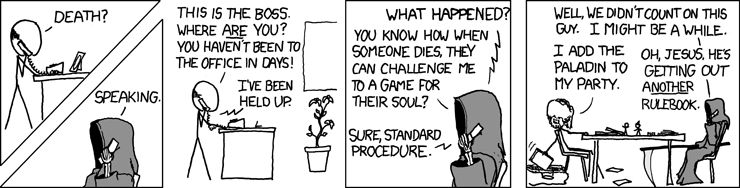
Death comes to us all. Knowing risks associated with a disease at least gives you the opportunity to prepare loved ones, make legal arrangements and make informed decisions about risky activities.
But of course, I have a backup plan to thwart death:
Sudden Unexpected Death in Epilepsy, or SUDEP is a term used when a person with epilepsy suddenly dies and the reason for the death is not known. The cause of SUDEP is unknown. Post mortem examination usually reveals no abnormalities in victims.Great. The napatorium just was redecorated in crypt.
Of those who die from SUDEP, it is most common in people who have generalised tonic-clonic seizures, especially in young adults. The most important 'risk factors' seems to be poor seizure control, and seizures occurring during sleep.
Applied Neurology describes the difficult role health care providers face when educating patients or condoling family members after an unexpected death.
It's a delicate subject, and some patients do not want to know that they are at risk for sudden unexpected death. The question is, does knowing serve a purpose? "When I talk to my epileptic patients, I highlight the risk of injury and accident with potentially fatal consequences," said Michael Sperling, MD, the Baldwin Keyes Professor of Neurology at Thomas Jefferson University and director of the Jefferson Comprehensive Epilepsy Center in Philadelphia. Sperling advises patients, for example, to avoid rock climbing and not to swim without a lifeguard nearby. "But to say, 'By the way, you could suddenly die, we won't know why, and there's nothing I can do about it'-I don't think that serves any useful purpose," he said.
How much should physicians tell patients about the risks of their conditions? Indecision may be bolstered by inaccuracies in data about SUDEP.
Apodaca writes:
In one American study a SUDEP rate of 1 in every 370 people with epilepsy has been suggested. (Leetsma et al 1989). It is however a fact that, through ignorance and misunderstanding - few doctors and even fewer coroners are aware of SUDEP - epilepsy related deaths have often not been accurately recorded and the exact number of deaths falling within the category of SUDEP is not known. By declaring a death resulting from a bath-time seizure as ‘drowning’, or a fatal nocturnal seizure as ‘suffocation’, and by not mentioning the epilepsy connection, valuable research data is being lost.
Personally, I want to know more rather than less. Accurate and comprehensive information helps me avoid inventing explanations to fill the gaps. I'm creative and can find reasonable sounding rationalizations that are about as real as intelligent design.
Certainly unexpected and sudden death is a terrifying prospect but so are many other aspects epilepsy. Individuals should be given access to correct medical information and retain control over how to mentally and emotionally process it. Having an incurable disease does not make you helpless or stupid. Being treated as incapable of facing difficult information is demeaning.Death comes to us all. Knowing risks associated with a disease at least gives you the opportunity to prepare loved ones, make legal arrangements and make informed decisions about risky activities.
But of course, I have a backup plan to thwart death:
Thursday, March 6, 2008
Excuse I Planned to Use Eliminated by British Idiot
From The Sun:
I Just Had a Fit You W*****
A DAD who made a rude gesture at a cop said he could not help it because he had just had a seizure.
Epileptic Michael Beakbane, 52, denied he was being abusive when he moved his hand up and down.
But traffic officer Philip Newell told a court: “I took it he was calling me a w*****.” (That's Britsh for asshole).
Details on the shenanigans with charming photo.Thursday, February 21, 2008
A Guide to Remember
A college age reader who is wrestling with adapting life, epilepsy, migraines, the universe and everything shared the frustrations of losing your memory.
I've written a lot about memory in the last week. I can't seem to hold information at my usual capacity. This is partially due to being overextended (Apartments available! Albany All Stars debut roller derby bout! Work!), but also hardware damage. It is immensely irritating.
Fortunately, my OCD tendencies are kickin' in and battling Team ADD and CRS.* Here are the weapons in my arsenal that may or may not help others with the forgetting. Some are tailored to students based on my experiences from law school when the aura seizures tag teamed with the basic curriculum requirements to create a formidable opponent.
1. Make To Do lists and recopy them every few days. My is usually at 50+ items (because I'm involved in waaaay too many fun projects that contribute to my feelings of insanity). I highlight & star priorities for the day.
2. Audio tape your lectures or important meetings. Most universities allow this for students--especially if there is a learning barrier. You can download the audio files and have a record to help flesh out confusing bits of notes.
3. Have a few people to swap notes with in class. They'll hear things differently and if you give them your notes it won't appear that you're trying to slack off in the pay attention in class department.
4. Carry a small notebook--I write down EVERYTHING. Things to buy, phone numbers, names of new acquaintances and identifiers, tasks to do, promises made, etc.
5. Tell people you might forget and arrange reminders for important meeting or events. Usually they can be automated electronic messages.
6. Inform your support network so they can help you out. For example, if migraine symptoms pop up have 5-10 people who you mass text or email to spark them into action. They can agree to specific roles (i.e. pick up notes or materials from your classes, drive you to the hospital, check on pets, reschedule appointments, etc.). It gets stuff done so you can pick up life more easily post migraine or seizure.
Having had migraines all throughout high school and college and almost monthly seizures in law schools, it also helped me a lot to just inform people about the body rebellions. It made it less scary and offered a practical response over panic. I have become more candid and laissez faire about privacy when it comes to the epilepsy. That might not be within your comfort zone.
-----------------
*Can't Remember Sh*t
Sunday, February 17, 2008
How to Respond to a Seizure
Enough of my blathering about my own head--here's what you can do in response to a seizure.
The Basics:
A comprehensive video from the UK that outlines how to respond to a complex partial seizure (the check-out) and a grand mal seizure (twitching):
(About 7 minutes)
Shorter video on complex partial seizures.
Shorter video on grand mal seizures (aka general tonic clonic).
The Basics:
- Do Something. You can actually help--don't stand their like a deer in the headlights. At least ask if you can help.
- The Signs: Before a seizure, its likely that a person will mentally check-out. They'll seem off as though they were suddenly drunk. For example: I get a sense of deja vu that focuses on smell and will generally ask for something with a strong scent (pepper is a favorite).
- Your Response: Stay Calm, reassure, look for a medical alert bracelet and ask "Do you have seizures?"
- Relocate: Have the person sit down on the ground. The goal here is to avoid a fall or let them wander into danger (like traffic).
- Assume the Position: If they go into a Tonic Clonic seizure (shaking & twitching) do these three things:
- Roll on Side
- Pad & Protect Head
- Time the seizure. Greater than 5 minutes= Call 911.
- DO NOT PUT ANYTHING IN THEIR MOUTH. They won't bite off their tongue. Jaws atwitchin' are not that strong.
- Remind them to breath if they are turning a bit blue.
- Be a Nice Person: Reassure them when they come out of it. They'll probably be really sleepy so get them to a napatorium or a cab so they can get home safely. If possible write down anything you observed before and after the seizure. It really helps with reconstructing time and generally helps them get back to the exciting world of day-to-day living.
A comprehensive video from the UK that outlines how to respond to a complex partial seizure (the check-out) and a grand mal seizure (twitching):
(About 7 minutes)
Shorter video on complex partial seizures.
Shorter video on grand mal seizures (aka general tonic clonic).
Thursday, February 14, 2008
Reverse LifeStreaming
My friend JKD wrote a provocative post about if we can glean any meaning from sharing personal experiences through the internets:
JKD also notes:
It makes me realized what wonderful people surround me. I could fill in a lot of gaps with my compulsive To Do lists, email archives, etc... which insures my ability to function independently. But I'm not really independent--I depend on a network of friends, family, peers and colleagues.
I feel really grateful.
And guilty.
And weak.
Epilepsy is forcing dependence. Depending on other people, especially when I'm mentally out of it and clawing for coherence, means acknowledging that I can't solve a problem myself.
Now rationally, I know that great solutions come through collaboration and are frequently much richer than what we can concoct alone. Emotionally, admitting that I do not have the capacity to solve a problem is extremely distressing. I HATE complaining or worse, appearing to be some weak, fragile, fainting flower of womanhood.
However, there is maturity in acknowledging I can't solve problems, don't have all the answers and will have to ask someone to focus their time and attention on my needs. If Lifestreaming illustrates anything, it is that regardless how much we prize our individuality and unique perspectives within our lives, we crave connections. Asking another to help you figure out a problem creates vulnerability as we describe our ignorance. Trusting others to not take advantage of a vulnerability is a risk and opportunity to build interdependence.
It is not a great revelation that building trust and interdependence needs mutual vulnerability. Why is taken on the extreme of the young, fainting, helpless belle so unappealing? Because she exploits the best instincts of her heroic rescuer.
Helping someone is a risk--it pulls us out of the familiar, tests our intellectual and emotional capacity and may have terrible outcomes (resentment, betrayal, misrepresentation or outright failure). Pulling someone from a burning car or repositioning a seizing epileptic means you could be holding a person as they die. Even offering advice or resources to help someone access new possibilities means that good intentions may go unappreciated, resented or radically change the relationship.
When someone embraces that risk and offers help with open arms, exploiting that instinct is a vile, selfish and almost unforgivable act. It severs the connections which weave our lives together. Those connections can hurt, but they also give our lives meaning and depth. I wouldn't be able to bounce back into life so quickly if I couldn't ask other people where my life was when the brain shut off. I'm grateful for everyone who take on the risk when I'm helpless and confused. It's nice to not have to go at it alone.
Lifestreaming, if it’s understood as an attempt to catalog every single thing that happens in a day and put it in some kind of infinitely-faceted context, is no more interesting than reading someone’s diary of every single thing they do in a day. Perhaps good for a lark - and a giving of thanks that you’re not yourself trapped by such a compulsion - but nothing of particular merit or worthy of striving for as a goal.We're all voyeurs, perhaps to reassure ourselves that our experiences are shared and normal even though they are uniquely ours. The interwub eases lifestreaming's hallmark sharing (and oversharing) process by at relieving the restraints of distance, time and language.
JKD also notes:
You wouldn’t want to post the entirety of your walk around the block - with video, audio, GPS coordinates, barometric pressure, etc. - as a lifestream entry. But maybe there was a moment when you looked up and to the left, and the sun glinted just so through the tops of the trees tipped with last night’s frost, and a hawk soared past. Maybe that would be worth both remembering and transmitting to the world (or your little slice of the Intarwub), with or without fuller context.Since the twitchyness yesterday, I've spent a bit of time in a reverse lifestream process. Today and yesterday I asked friends to recap conversations, on-going projects and what I've promised to accomplish. Interestingly there are quite of few of them who seem to believe that I'm going to send them oodles of cash. I may not be the only one who is delusional. :)
It makes me realized what wonderful people surround me. I could fill in a lot of gaps with my compulsive To Do lists, email archives, etc... which insures my ability to function independently. But I'm not really independent--I depend on a network of friends, family, peers and colleagues.
I feel really grateful.
And guilty.
And weak.
Epilepsy is forcing dependence. Depending on other people, especially when I'm mentally out of it and clawing for coherence, means acknowledging that I can't solve a problem myself.
Now rationally, I know that great solutions come through collaboration and are frequently much richer than what we can concoct alone. Emotionally, admitting that I do not have the capacity to solve a problem is extremely distressing. I HATE complaining or worse, appearing to be some weak, fragile, fainting flower of womanhood.
However, there is maturity in acknowledging I can't solve problems, don't have all the answers and will have to ask someone to focus their time and attention on my needs. If Lifestreaming illustrates anything, it is that regardless how much we prize our individuality and unique perspectives within our lives, we crave connections. Asking another to help you figure out a problem creates vulnerability as we describe our ignorance. Trusting others to not take advantage of a vulnerability is a risk and opportunity to build interdependence.
It is not a great revelation that building trust and interdependence needs mutual vulnerability. Why is taken on the extreme of the young, fainting, helpless belle so unappealing? Because she exploits the best instincts of her heroic rescuer.
Helping someone is a risk--it pulls us out of the familiar, tests our intellectual and emotional capacity and may have terrible outcomes (resentment, betrayal, misrepresentation or outright failure). Pulling someone from a burning car or repositioning a seizing epileptic means you could be holding a person as they die. Even offering advice or resources to help someone access new possibilities means that good intentions may go unappreciated, resented or radically change the relationship.
When someone embraces that risk and offers help with open arms, exploiting that instinct is a vile, selfish and almost unforgivable act. It severs the connections which weave our lives together. Those connections can hurt, but they also give our lives meaning and depth. I wouldn't be able to bounce back into life so quickly if I couldn't ask other people where my life was when the brain shut off. I'm grateful for everyone who take on the risk when I'm helpless and confused. It's nice to not have to go at it alone.
Slight Brain Malfunction & Valentine's Day Love
My coworkers are some of the greatest people on the planet. I wanted to thank them publicly for taking care of me yesterday as I had a series of aura seizures.
Today I'm a little fuzzy and strangely aware of just how much I have on my plate.
So here's what I've learned in the last twenty-four hours:
Our time in this life is short and I treasure these reminders that living joyfully and with gratitude leaves a soft mark on those with whom I'm privileged to share each day.
Thanks.
Today I'm a little fuzzy and strangely aware of just how much I have on my plate.
So here's what I've learned in the last twenty-four hours:
- I HATE admitting to myself that I have epilepsy. I hate it. I do admit it because I'm not irrational and realize that I can't actually deny it. But I hate having it. I don't have control over my own body. It will defy me, act naughty and I can't do a damn thing (except take my medications and generally be nice to myself).
- Losing chunks of time from memory loss is much less intimidating when friends help with reconstruction. Sometimes I can figure out things myself but insights from friends speed things along. For example, I need bloodwork done this week and couldn't remember if I had skulked over to the medical center. A lack of holes in my arms clued me that that remains a fun activity for the week. However, response to a mass email helped a bunch--though the majority of my friends seemed convinced that I was about to write them rather large checks. Those babies are in the...ahem...mail. Good luck getting them to clear.
- The memory does come back. For that, I'm eternally grateful. My greatest fear is losing it altogether. Since I'm involved in a ridiculous number of projects, my brain is stimulated. I started the morning working through spreadsheets for a rental property side business. The stimulus and imperative to get stuff done eliminates the excuses that lurk along with my lazy tendencies.
- Friends--I couldn't do it without you. Friends includes family and coworkers. You help me back into rhythm which straightens up the jumbled mess in the brain. Thank you.
- Charlotte & Lisa: Thanks for dealing with the immediate concerns and remaining calm.
- June & Mike: Thanks for my pretty new bracelet--the most useful piece of jewelry I own and squirrel references are a good clue to the natural state of wackiness.
- AASRD: Thanks for keeping me on track. And on the track.
- Alan: The detailed timeline was a beautiful grounding.
- MO: Getting out of the house last night was essential and not just for caloric intake.
Our time in this life is short and I treasure these reminders that living joyfully and with gratitude leaves a soft mark on those with whom I'm privileged to share each day.
Thanks.
Subscribe to:
Posts (Atom)
